
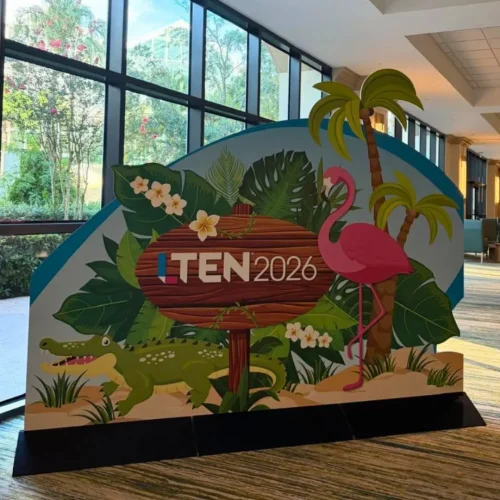
LTEN 2026 surfaced something worth paying attention: the L&D conversation in life sciences has shifted. The questions on the floor were sharper, the challenges more complex, and the appetite for real strategic thinking is more visible than it has been in years. These are the five ideas that stayed with us after the sessions ended.
Stop proving value. Start making it visible.
Dr. Keith Keating opened with a reframe that the room needed. The instinct in L&D has always been to justify investment by producing ROI metrics, completion rates, and assessment scores. Business leaders do not respond to those in isolation. They respond to stories that connect learning to outcomes they already care about: their people performing better under pressure, their organization absorbing disruption without fracturing, their customers receiving something better because of it.
His hidden value framework organized this around four areas: empowering people, driving business growth, building organizational resilience, and delivering customer value. The argument is not that metrics are wrong. It is that metrics without narrative quietly disappear from the conversation when L&D is not in the room. If you are not making the value visible, repeatable, and easy for a business leader to retell, you are leaving your own case on the table.
For life sciences L&D teams, this has a particular application. Field readiness training has direct commercial consequences. When an FRM understands a prior authorization pathway clearly enough to prevent a denial, that is a patient access win and a revenue protection story. When a KAM can hold a credible scientific conversation with a specialist, that relationship is worth more than any engagement metric in a dashboard. The work is to connect those field moments back to the strategic value story in a way leaders can recall and repeat.
Organizational reach matters as much as functional depth
Amity Cutaia from Astellas offered a useful frame: the best trainers operate less like specialists and more like the organizational equivalent of an octopus. They extend reach across functions, find paths around structural blockers, and stay adaptive when the environment shifts.
It lands because it describes what actually separates high-performing L&D functions from ones that are perpetually underfunded. A training team that operates only within its own lane, producing content and waiting to be asked for it, will always struggle to demonstrate strategic relevance. The teams that earn a seat at the commercial planning table are the ones that understand what sales leadership is worried about, what medical affairs is navigating, and what market access is trying to solve, and then build programs that address all three.
In a rare disease context, where field teams are small and every function is calling on the same accounts, this cross-functional orientation is not a nice-to-have. It is a requirement.
The industry is ready for a different kind of conversation
One of the clearest signals from LTEN this year was not from any single session; it came from the quality of conversations on the floor.
The questions have changed. A few years ago, the typical exchange at a life sciences L&D conference was about tools, platforms, and content volume. This year, the conversations moved into harder territory: how do you build training programs that hold up inside a commercial organization that is scaling faster than its infrastructure? How do you measure field behavior change in a way that the business will actually act on? How do you design for a team that has never commercialized a product before?
That shift in the quality of the question reflects a shift in what the industry is prepared to pay for. There is a real appetite for training partners who come in with a strategic point of view, not just a catalog. That is an important signal for anyone building or evaluating an L&D function in life sciences right now.
Launch training is being rebuilt from the ground up
Ariella Sax and Natasha Ilincic drew a full room for their Learning Lab on the five mindset shifts redefining launch readiness. The five areas they covered were continuous readiness, personalization, real performance, content ecosystems, and readiness intelligence.
Each of those represents a genuine break from the way launch training has been designed historically. Continuous readiness is a direct challenge to the pre-launch sprint model, where all training is front-loaded before the PDUFA date and then largely abandoned. Readiness intelligence is a challenge to the LMS completion dashboard as the primary indicator of field preparedness. And real performance is the one that should provoke the most reflection: training that does not change what reps do in the field has not done its job, regardless of how many modules they completed.
The room was full because commercial leaders in life sciences know that launch training built on the old model is not fit for the complexity of their deployment environment. The question they are bringing to conversations with training partners now is not “can you build content?” It is “can you actually prepare my team for what they are about to face?”
Excellence is built in practice, not in certification
Laura Last from BeOne made a point that deserves more attention than it typically gets in professional development conversations: you cannot build excellence by accumulating credentials or mastering a single discipline. Excellence comes from developing yourself across multiple dimensions, consistently, over time. And the difference between potential and performance comes down to preparation and practice.
That is easy to agree with in a conference hall. It is harder to act on inside an organization where L&D budgets are evaluated by training hours completed and where the pressure to show fast outputs pushes teams toward content production over genuine capability development.
The application for life sciences L&D is straightforward, if demanding field excellence in a rare disease launch or a complex specialty product introduction does not come from a rep who has passed every module. It comes from a rep who has practiced the hard conversation enough times that they can handle it under pressure, without a script, in front of a specialist who has seen every approach before. Building that capability takes a different kind of investment than most launch training programs are currently designed to provide.
LTEN 2026 confirmed that the industry is ready to move beyond the basics. The practitioners in that room are not asking for more content. They are asking for better thinking about what training is actually for and what it should be doing in the field. That is the conversation worth having.